Stakeholder management tools are software that help teams keep engagement organized on large, complex projects. They add value to almost any major build, but on a linear infrastructure project, they're essential.
Delivering a linear infrastructure project means building across a corridor rather than a single site. A road, a rail or transit line, a high-voltage transmission line, a pipeline, or a water network can run for hundreds of kilometres, cross many jurisdictions, and take years to complete. Data centre developments raise similar challenges, as they require land, power, water, and community acceptance simultaneously.
Along the way, you have to communicate with a wide range of stakeholders who each have different concerns and different timelines: landowners, Indigenous and Tribal nations, municipalities, regulators, utilities, government agencies, contractors, and the residents and communities living near the work.
Stakeholder management software gives teams a single, secure place to manage it all. You can log every interaction, track the issues and commitments raised along the route, keep a complete history that survives staff changes, and produce the reports that regulators and the public expect, instead of relying on the scattered spreadsheets, inboxes, and shared drives that large projects otherwise fall back on.
Below, we cover who those stakeholders are, the problems teams hit when engagement isn't centralized, and 9 tools built to help.
Who are the stakeholders on a linear infrastructure project?
Linear infrastructure stakeholders are highly interconnected, and because these projects cross many jurisdictions, the list is long. The specific agencies and laws differ from one country to the next, but the main players are consistent whether you're building in North America, the UK, Europe, or Australia:
-
Project proponents and financiers: utilities, pipeline and transmission developers, and the private equity, banks, and institutional investors backing them.
-
Federal regulators: agencies like the Federal Energy Regulatory Commission, the Department of Transportation, and the Environmental Protection Agency, with reviews under the National Environmental Policy Act.
-
State and local government: utility commissions and zoning boards that approve routing, grant land-use rights, and issue construction permits.
-
Private landowners: property owners in the path of the right-of-way (ROW) who negotiate easements or contest eminent domain.
-
Indigenous and Tribal nations and communities: sovereign nations that must be consulted (Section 106 in the US, the Crown's duty to consult in Canada), alongside residents' associations and neighbours.
-
Advocacy and environmental interests: environmental groups that monitor ecological impacts and can litigate, and regional grid operators that coordinate interconnection on transmission projects.
-
Local communities: residents, neighbourhoods, and residents' associations, and community groups concerned with property values, visual impact, and construction disruption.
What are the problems teams managing stakeholders on linear infrastructure projects experience?
Teams managing linear infrastructure projects that haven't centralized their stakeholder engagement keep running into the same problems:
-
A developer building a 400-mile transmission line has to track landowners, communities, and regulators along the entire route, log years of engagement, map coverage and risk areas, and still produce audit-ready reports for permitting.
-
A consultant working across many infrastructure projects stuck with manual Excel and email sprawl is under pressure as volume grows, and doesn't want to run a different software product for every project.
-
A state railway is juggling separate projects with different circles of stakeholders, from a transport ministry to municipalities to passengers with disabilities. It needs a better way to manage, track, and report on them all.
-
A housing and land agency tracks engagement across email and spreadsheets, can't keep a single source of truth, and risks missing commitments or sending inconsistent messages.
-
A project development lead has a North American team on one construction tool and an Australian team on another, and wants to centralize so that knowledge is retained across projects even when people leave.
-
An offshore gas project worth billions needs to coordinate governments, partners, and contractors, engage host communities, and keep up with environmental, social, and governance (ESG) and compliance reporting across a multi-year lifecycle.
The thread running through all of these is the same: many relationships to manage at once, over years, and constant pressure to prove you engaged when a regulator, a court, or the public asks. A spreadsheet or a sales CRM (customer relationship management) system isn't built for this.
What linear infrastructure teams need is a dedicated stakeholder management tool. Below are 9 worth knowing, grouped by what they do, and the kind of team each one suits.

Stakeholder management software for linear infrastructure projects comparison table
| Platform | Starting price | Key strength |
| Jambo (SRM) software | From US$995/month (annual, 5 users) | Purpose-built stakeholder management software for engagement records, issues and commitments, audit-ready reporting, AI sentiment and GIS map viewer. |
| Borealis | Custom (by quote) | Engagement tied to land access and asset management |
| Open Point | Custom (by quote) | Combined internal SRM and public engagement |
| Citizen Space (Delib) | From £10,495/yr | Statutory public consultation at scale |
| Terra Reporting | Custom (by quote) | Engagement inside an ESG and CSRD platform |
| Trimble TILOS | Custom (by quote) | Linear scheduling with time-location diagrams |
| Oracle Aconex | Custom (by quote) | Document control and audit trails for megaprojects |
| Socialsuite | Custom (by quote) | Stakeholder input feeding ESG disclosures |
| Simply Stakeholders | Custom (by quote) | Strong stakeholder mapping |
See our comparison of the best stakeholder engagement reporting software to consider →
9 stakeholder management tools for linear infrastructure projects
These stakeholder management tools are built specifically to track whom you engaged, what was said, what you promised, and what's still outstanding.
1. Jambo
Jambo is stakeholder management software, built for teams who need to prove they engaged.
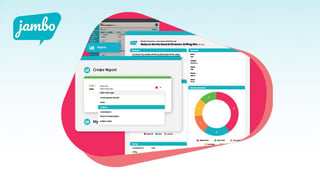
With Jambo, you can log every communication (email, meeting, phone call, site visit), track issues and commitments so nothing is forgotten, and generate consultation and compliance reports in a few clicks. Records are auto-linked to the relevant contact or organization, so the full history of a relationship is always in one place, and it survives staff turnover. When someone leaves, everything they logged stays in Jambo.
For linear and corridor work specifically, a few things stand out. The 'Lands' contact type lets you log engagement associated with a location, such as a parcel, rather than the current owner, which matters as land can change hands over a long right-of-way (ROW) acquisition.
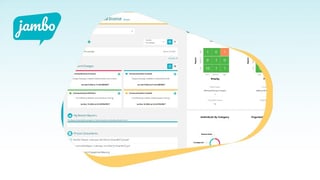
Confidential contractor roles and permissions let field staff and partners contribute data without seeing restricted records, so you can run corridor-wide engagement across segments and work packages without creating data silos. Built-in Esri map viewers show where engagement is happening and let you filter by issues, so you can spot gaps and risk areas along a route. And because the system is project-based with role-based permissions, it fits public-private partnership (P3) structures and supports key performance indicator (KPI) reporting to authorities.
Jambo works well for infrastructure development use cases, including transit and rail lines, transmission lines, roads and highways, ports, and data centre builds. For data centres, the stakeholder map typically spans municipalities, Indigenous communities, landowners, utilities, regulators, and residents, and Jambo helps developers and their engagement consultants manage that complexity together in one platform.
Jambo is trusted by governments and organizations worldwide, with offices in Canada, Ireland, and Croatia, and it's available in English and French.
Buyer type: Infrastructure, transportation, energy, and government teams that need one secure system of record to track engagement, manage issues and commitments, and produce audit-ready reports, wherever in the world they operate.
Key features:
For linear infrastructure specifically, Jambo lets teams:
-
Log every communication and interaction with landowners and rights holders using a dedicated land contact type, so the engagement history stays attached to the location even if it changes hands during a lengthy acquisition process.
-
Track issues, grievances, and commitments (easements, access, compensation) on a dedicated timeline with assigned follow-up tasks, so nothing gets forgotten over a multi-year build.
-
Give contractors and field staff a confidential contractor access role, so they can log data without seeing confidential records.
-
Run detailed or summarized reports in a few clicks to satisfy DOT (Department of Transportation), municipal, or regulatory reporting requirements.
-
Keep all logged data permanently, so a departing team member never takes institutional knowledge with them.
-
Distill years of corridor consultation into permitting and regulatory reports with AI. Summarize and flag a landowner or community turning negative before approvals are delayed using AI Sentiment.

2. Borealis
Borealis is an enterprise stakeholder engagement platform acquired by Irth Solutions, an infrastructure software provider headquartered in Columbus, Ohio, backed by TPG. The combined offering pairs Borealis's stakeholder and community relations tools with Irth's land management, damage prevention, and asset integrity capabilities. It handles complex land access and grievance tracking.
The acquisition is worth weighing as a long-term decision. Roadmaps, pricing, support contacts, and standalone feature development can all shift when a product is folded into a larger suite. The combination may well strengthen the platform, but it's fair to ask Irth about the roadmap, pricing, and support commitments before signing a multi-year contract, as you would with any acquired product.
Buyer type: Large energy, utility, and telecommunications operators that want stakeholder engagement tied to land and asset management.
Key features:
-
Stakeholder engagement, land access, and grievance tracking.
-
Geospatial context and AI-powered insights.
-
Now integrated with Irth's asset integrity and damage prevention tools.
See our comparison of Jambo vs Borealis for a comprehensive →
3. Open Point, formerly Consultation Manager
Open Point is the unified brand, launched in 2026, that brings together two Australian products: Consultation Manager (the stakeholder relationship management side) and Social Pinpoint, now called Social Point (the public community engagement side). It's used in the Australian infrastructure market. It combines internal stakeholder records and public engagement, with project mapping linking land parcels to communication timelines.
Buyer type: Teams, especially in Australia, that want stakeholder management and public engagement under one connected platform.
Key features
-
Combined stakeholder relationship management and public community engagement.
-
Project mapping connecting parcels to engagement history.
-
Complaint and issue tracking, with cross-project comparison of themes and stakeholder sentiment.
4. Citizen Space by Delib
Citizen Space is Delib's consultation platform, used by more than 600 government organizations, including UK public bodies, regulators, and national infrastructure projects running statutory and regulatory consultations. It handles large-scale public consultations, statutory notices, and feedback analysis, with an emphasis on accessibility and GDPR (General Data Protection Regulation) compliance.
Buyer type: UK public bodies and infrastructure authorities running high-volume statutory consultations.
Key features:
-
Statutory and regulatory public consultation management.
-
Transparent feedback analysis and a public consultation hub.
-
Accessibility and GDPR-focused design for UK public bodies.
5. Terra Reporting
Terra Reporting is an ESG platform built on Microsoft Cloud for Sustainability. It isn't dedicated engagement software, but it includes stakeholder engagement features for coordinating communication, collecting feedback through surveys, and improving transparency, all of which are integrated with ESG data and reporting workflows aligned with the EU's Corporate Sustainability Reporting Directive (CSRD).
Buyer type: European organizations that want stakeholder engagement embedded in a broader ESG and CSRD reporting platform.
Key features:
-
ESG data management and CSRD-aligned reporting.
-
Double materiality assessment tooling.
-
Stakeholder collaboration and feedback tied to sustainability disclosures.
6. Trimble TILOS
TILOS is Trimble's linear scheduling software, originally developed by Linear Project GmbH in Germany before Trimble acquired it. It's widely used for linear infrastructure planning and merges the schedule, site constraints (such as traffic control or environmental restrictions), and geographic location into a single time-and-distance graphical view. That makes it easy to share visual progress updates with external stakeholders on highways, rail, pipelines, and transmission lines.
Buyer type: Planners on linear projects who need to communicate the schedule and location together.
Key features:
-
Time-location diagrams that combine schedule and geography.
-
"What-if" scenario planning for linear work.
-
Integration with Oracle Primavera P6, Microsoft Project, and Trimble tools.
7. Oracle Aconex
Aconex is built for megaprojects where stakeholder communication intersects with construction execution. It's built for large, complex infrastructure projects, managing heavy documentation, audit trails, and workflows across teams. Stakeholder-facing items, such as notices of work and requests for information (RFIs), can be handled within the same document-controlled environment.
Buyer type: Megaprojects that need rigorous document control and audit trails across many organizations.
Key features:
-
Document control with version history and audit trails.
-
RFI, correspondence, and workflow management at scale.
-
Handover and BIM (building information modelling) collaboration.
8. Socialsuite
Socialsuite is focused on environmental, social, and governance (ESG) reporting and materiality rather than day-to-day engagement logging. It's a fit when a linear project needs to tie community feedback, Indigenous engagement, and environmental grievances directly into executive sustainability reports and disclosures, including double materiality assessments.
Buyer type: Projects that need stakeholder input to feed directly into ESG disclosures and executive sustainability reporting.
Key features:
-
ESG and double materiality assessment tooling.
-
Stakeholder engagement linked to sustainability reporting.
-
Peer benchmarking and disclosure alignment.
9. Simply Stakeholders
Simply Stakeholders is a stakeholder register that centralizes contacts, interactions, and issues. It includes stakeholder mapping, relationship health scores, dashboards and reporting, and sentiment and qualitative analysis.
Buyer type: Teams that want a platform with stakeholder mapping and analysis.
Key features:
-
Stakeholder register, stakeholder mapping and relationship health scores.
-
Custom dashboards and scheduled reports, with sentiment and qualitative analysis.
-
Optional modules for grievance management, geographic mapping, and social investment tracking.
See our comparison between Jambo SRM software and Simply Stakeholders →
How can stakeholder management software be used in linear infrastructure projects?
The way a dedicated system earns its place varies a bit depending on the project. Here's how teams put stakeholder management software to work across common linear use cases:
-
Data centres: Data centres are among the hardest projects to develop right now, because they need land, power, water, and community acceptance all at once. The stakeholder map usually spans municipalities, Indigenous communities, landowners, utilities, regulators, and local residents. Teams use the software to track every contact and interaction across each site, manage issues and commitments in real time, control who can see confidential records, and generate consultation reports when regulators or approvals processes require them.
-
Rail and transit lines: stakeholders include transport ministries and municipalities, landowners along the route, passengers (including those with disabilities), and nearby residents. The software keeps corridor-wide engagement organized across segments and work packages, so continuity holds as teams and contractors change.
-
Transmission lines: track landowners, communities, and regulators along a route that can run for hundreds of miles, log years of engagement, visualize coverage and risk areas on a map, and produce audit-ready reporting for permitting and compliance.
-
Roads and highways: manage construction-phase engagement such as detours, lane closures, and noise by recording every notification sent to residents and businesses, tracking concerns raised and mitigations promised, and running progress reports for departments of transportation and municipalities.
-
Ports, pipelines, and other heavy civil: handle ROW and land access with location-based records, manage grievances and commitments over long acquisition timelines, and demonstrate engagement when challenged legally or publicly.
How do I choose the right stakeholder management tool?
No single tool does everything well, so start with the problem that hurts most. If your core need is proving you engaged, tracking commitments, and producing audit-ready reports across a corridor or a multi-year program, a purpose-built stakeholder relationship management system is the foundation, and that's the gap Jambo is designed to fill. If your priority is broad public input, a consultation platform like Citizen Space is a better fit. If sustainability disclosure is driving the work, an ESG platform like Socialsuite or Terra Reporting makes sense.
Most linear infrastructure project teams end up combining a system of record for engagement with GIS for spatial analysis and scheduling, or with scheduling or construction tools for delivery, rather than expecting a single product to cover it all. That's why integration matters, and it's worth confirming how each tool connects to the others you already run.
If you're weighing whether a dedicated stakeholder relationship management system is the right foundation for your linear infrastructure program, we're always happy to have that conversation. You can book a demo with us or read through our buyer's guide.