For teams in mining, energy, infrastructure, and government, a complete engagement report needs four things: a timestamped audit trail of every interaction, sentiment logged against each communication, an issue register showing what was raised and how it was resolved, and commitment tracking that proves follow-through. Environmental assessments, Indigenous consultation requirements, and standards like IFC Performance Standards all expect this evidence in a documented, repeatable format.
A spreadsheet can hold the raw data, but it can't produce these outputs on demand. That's the gap purpose-built Stakeholder Relationship Management (SRM) software fills, and where Jambo differs from a generic CRM: reporting is the design priority, not an afterthought.
From greenfield teams with nothing but a spreadsheet to teams paying for tools that were never built for stakeholder engagement.
700+ contacts engaged over email and tracked in a single spreadsheet leave teams with no way to produce the engagement report when it's asked for. When reporting time comes, it's a scramble.
Regulatory and compliance reporting, including environmental assessments, Indigenous consultation, IFC Performance Standards, and government-mandated disclosures, all demand structured, documented evidence of engagement. A spreadsheet won't stand up when a regulator or auditor asks for that record.
Executives and board members want clear project summaries: stakeholder sentiment, issue trends, and what the team has been working on, both at year-end and throughout the project. Assembling that from raw records by hand is a quarter's worth of work, not a morning task.
Registry bodies, holding companies, funders, and partner governments each expect reporting in their own format. Teams end up rebuilding the same underlying data into a different report for every one of them.
Are there gaps in our engagement? What are the dominant concerns? Is sentiment improving? Which issues are still open? These are standard questions. For most teams, the data to answer them exists somewhere, but it isn't organized in a way that makes it fast to monitor, analyze, and find the answer.
Teams using tools that weren't built for stakeholder engagement often find reporting cumbersome, the data hard to manage, or reporting missing altogether. It wasn't a factor when the tool was chosen, and now they're stuck having to fix that decision.
|
Manual reporting (spreadsheets and email) |
Reporting in Jambo |
|
Days spent assembling reports from spreadsheets and email threads |
Summary or detailed reports generated in seconds from any filtered view |
|
No sentiment tracking and no historical trend data |
Sentiment logged and filterable on every interaction record |
|
Critical context is locked in individuals' heads or inboxes |
Full engagement history, searchable across the entire project |
|
No audit trail for regulators, funders, or legal review |
Timestamped audit trail built for regulatory and funder requirements |
|
Board and C-suite reporting is manual, inconsistent, and often late |
Custom dashboards and summaries for every reporting audience |
|
No way to track KPIs, open issues, or commitments over time |
KPI tracking, issue dashboards, and commitment logs are maintained continuously |
|
Multi-team data entry produces inconsistent, incomparable outputs |
Multi-team entry standardized through structured records |
Capture every interaction, issue, commitment, and communication, timestamped and linked to the stakeholder who raised it. Searchable across the whole project and structured for regulatory, legal, or funder review. This is the fix for the spreadsheet-with-no-record problem.
Map engagement by location to spot hotspots, filter by land area or community, and produce location-based evidence for environmental assessment submissions.
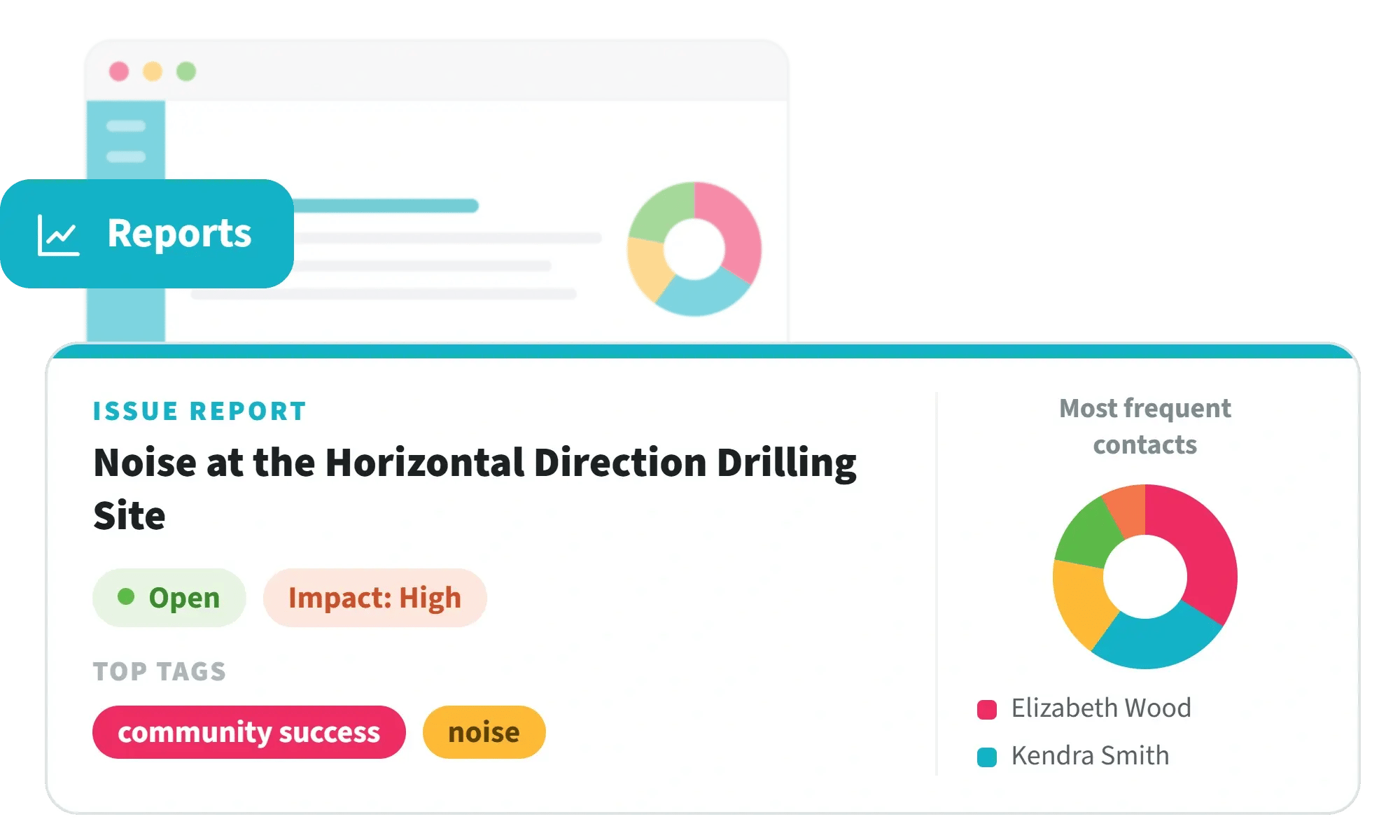
Build dashboards for issues, tasks, and engagement activity, with separate views for field teams, managers, and executives. This directly addresses the board and analysis problems: the year-end picture is live, not assembled by hand.
Track every issue from first contact to resolution, with status, owner, and linked communications always visible. Produce issue timeline reports with responses for permit applications or board updates.
Log sentiment on every communication and track how it shifts over time. Filter by sentiment to catch concerns early and show regulators or boards you're responsive.
Export engagement data as tables, charts, or graphs, including bilingual French and English outputs for projects under bilingual reporting requirements.
Generate detailed or summary reports from any filtered view, by project, stakeholder group, date range, issue, or communication type. Export to PDF or CSV with no manual assembly. This is what turns reporting time from a scramble into a task.
Projects undergoing provincial or federal environmental assessment processes require evidence of meaningful Indigenous consultation and community engagement.
Jambo's audit trail, timestamped communication records, and geospatial mapping give assessment teams the structured documentation that submissions require.

Teams required to submit reports to federal or provincial governments, including those subject to Indigenous consultation requirements, environmental legislation, or project approval conditions, use Jambo to generate structured engagement summaries that meet submission standards without having to rebuild them manually each reporting cycle.
Teams operating under IFC Performance Standards, carbon registry requirements, or ESG disclosure frameworks need consistent, repeatable reporting.
Jambo enables structured data entry across multiple teams so outputs are comparable across reporting periods.

|
|
International Finance Corporation standards require projects to identify affected stakeholders, disclose information, and document ongoing engagement, especially under Performance Standard 1. Jambo maintains the engagement log and issue register on which these reviews depend. |
|
|
The documented duty to consult and, where relevant, accommodate Indigenous and Tribal nations affected by a project. Jambo timestamps every interaction and links it to the community that raised it, producing the record consultation reviews require. |
|
|
Provincial and federal processes that assess a project's impacts before approval, including its engagement record. Jambo provides the audit trail and geospatial evidence that the assessment branches ask for. |
|
|
Environmental, Social, and Governance reporting requires organizations to evidence how they engage affected communities. Jambo turns raw engagement activity into the structured summaries disclosure frameworks expect. |
|
|
Carbon project registries require documented, verifiable stakeholder consultation as a condition of credit issuance. Jambo's repeatable exports keep that evidence consistent across verification periods. |

|
|
Internal reporting that gives executives and directors a clear view of sentiment, issue trends, and engagement activity. Jambo's dashboards produce this from live data rather than from a manual quarterly assembly. |
|
|
Funders, holding companies, and partner governments each set their own reporting expectations. Jambo generates consistent outputs from a single record set, so teams don't have to rebuild the same report in multiple ways. |


|
|
Reporting obligations that require outputs in both French and English, Jambo exports tables, charts, and summaries in both languages from the same data. |
Here, you can find answers to the most commonly asked questions about stakeholder engagement reporting software.
If you don't find the answer you're looking for, our friendly sales team is always here to help. You can contact us at hello@jambo.cloud.
Terms and Conditions | Privacy Policy | Accessibility Statement | © 2026 all rights reserved