
Jambo is trusted by governments and organizations worldwide
























































Frequently Asked Questions (FAQs) about the stakeholder management strategy template
Here, you can find answers to the most commonly asked questions about Jambo's stakeholder management strategy template.
If you don't find the answer you're looking for, our friendly sales team is always here to help. You can contact us at hello@jambo.cloud.
What's the difference between stakeholder analysis and stakeholder management strategy?
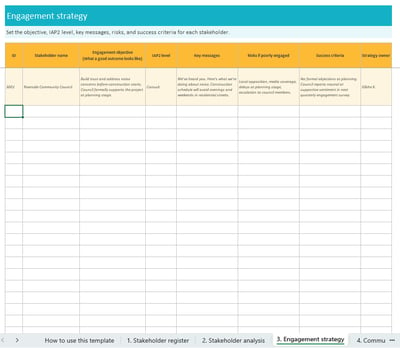
Analysis is the working record of who your stakeholders are, where they sit on the power-interest matrix, and how they feel about your project. Strategy is what you decide to do about it: the engagement objective for each stakeholder, the IAP2 level of participation, the communication method and cadence, the owner, and how you'll measure success. The analysis template is the snapshot. The strategy template is the plan.
What's IAP2, and why is it in the template?
IAP2 is the International Association for Public Participation. Their spectrum of public participation defines five levels of engagement (Inform, Consult, Involve, Collaborate, Empower) that are widely used in stakeholder engagement and consultation work. Setting an IAP2 level for each stakeholder forces you to be explicit about how much influence they actually have on the decision, which is one of the most useful conversations a project team can have early.
Can I use this template for Indigenous engagement?
The categories in this template are designed for stakeholder management. Indigenous peoples have constitutionally protected rights that change the nature of the engagement, so they shouldn't be tracked alongside other stakeholders in the same record. We recommend creating a separate Indigenous engagement record, which we cover in our beginner's guide to stakeholder engagement.
How often should I update this template?
Strategy isn't static. We recommend three review cadences:
- After every significant interaction, update the measurement tab and the sentiment column for that stakeholder
- Monthly or at project milestones, review the strategy and communications plan tabs to check whether your engagement objective and cadence still hold
- When something changes (a stakeholder's sentiment shifts, a new issue emerges, or a team member joins or leaves), revisit the engagement objective for affected stakeholders and adjust cadence or method
What happens when a spreadsheet isn't enough?
For a single project with a manageable number of stakeholders, this template works well. Once you're managing multiple projects, hundreds of stakeholders, or you need to track commitments, issues, and full communication history across teams, a spreadsheet starts to break down. That's where SRM (stakeholder relationship management) software like Jambo helps. We cover the limits of spreadsheets in our guide on switching from spreadsheets to SRM software.
Check out some of our other helpful stakeholder engagement resources


Ready to manage stakeholder relationships at scale?