
Jambo is trusted by governments and organizations worldwide



























































Frequently Asked Questions (FAQs) about whether you should stop using spreadsheets for stakeholder engagement
Here, you can find answers to the most commonly asked questions about Jambo's scoring sheet.
If you don't find the answer you're looking for, our friendly sales team is always here to help. You can contact us at hello@jambo.cloud.
How is this different from a regular spreadsheet checklist?
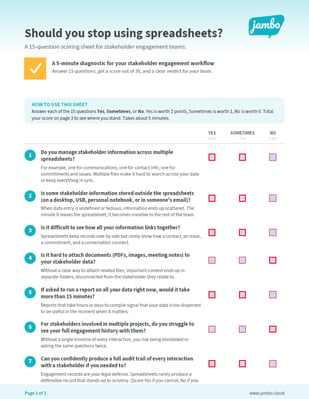
A checklist just gives you a list of yes/no questions. This is a scoring sheet: each answer carries a point value, the total comes out of 30, and there's a 4-tier verdict that tells you whether you're fine, watching for problems, in real trouble, or actively hurting your team. The shift from "yes, I ticked some boxes" to "we scored 19/30" is what makes this useful for internal conversations.
Do I have to be ready to switch software to use this?
No. The scoring sheet works even if you've never considered switching. The 15 questions surface problems that are easy to ignore day-to-day but compound over time. Some teams use it as a regular health check; others use it as the first step in a software evaluation. A low score is still useful information.
Will the score really auto-calculate?
In most desktop PDF readers (Adobe Acrobat Reader, Preview on Mac, Foxit, Nitro), yes. In browser-based PDF viewers (Chrome's built-in viewer and some mobile readers), the radio buttons still work, but the total may not be calculated automatically. In that case, just add it up by hand and enter the total in the score field. The sheet is built to work either way.
Is this only relevant if I'm using Excel?
No. The questions apply whether you're in Excel, Google Sheets, Numbers, or any combination of them. The issues come from spreadsheets as a category, not from any specific tool.
Can I share this with my team?
Yes. Many teams use this as a 20-minute exercise: everyone fills it in independently, then compares scores. The disagreements (one person scoring 8, another scoring 22 on the same team) are often more useful than the average, because they surface where individuals are feeling the pain others haven't yet noticed.
Why does my score include a Sometimes option?
Because real life isn't binary. "Sometimes" lets you score honestly when something is occasionally a problem, but not always. Forcing a Yes /No often pushes people toward the easier answer, making the diagnostic less useful.
Check out some of our other helpful stakeholder engagement resources




Past the diagnosis stage?
If you've already realized spreadsheets aren't enough and want to see what better looks like, book a 15-minute call. We'll walk you through how Jambo handles the issues this scoring sheet surfaces.